

Tension springs are one of those parts you never really notice until they stop working. Pull one, and it fights back, storing that energy, then pulling everything back into place the moment you let go. That single mechanical trick, resisting a pulling force and returning to its original length, is why tension springs show up in everything from garage doors to automotive assemblies. If you’re sourcing components for a project and searching for tension spring manufacturers, understanding what actually separates a good spring from a mediocre one will save you time, money, and a lot of frustration down the line.
What exactly is a tension spring?
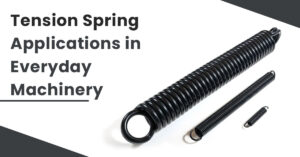
People use the term extension spring just as often, and it means the same thing: a tightly wound length of wire designed to resist being pulled apart. Where a compression spring pushes back when squeezed, a tension spring resists stretching instead. Both ends usually carry a hook, loop, or custom-formed connector tying the spring into whatever mechanism it’s driving.
At rest, the coils sit almost touching. Pull the ends apart and they separate, quietly storing energy. Let go, and that stored force pulls the mechanism straight back to where it started.
Common types of tension springs
Not every tension spring looks or performs the same way, and picking the wrong type for an application is a surprisingly common mistake.
Machine hook springs are the simplest of the lot: simple loop ends, dependable in lower-load settings like small appliances or hand tools. Extended hook springs push the hook out past the coil body, which matters when mounting geometry doesn’t leave room for a standard hook. Conical tension springs trade the usual cylindrical shape for a tapered one, useful in tight spaces where a variable spring rate is still needed. Double torsion-tension hybrids are rarer, designed for mechanisms that need rotational and pulling forces to work together at once.
Material choice matters just as much as shape. Springs are commonly manufactured from carbon steel, stainless steel, or alloy steel, depending on load requirements, environmental exposure, and expected cycle life. A spring destined for an outdoor agricultural machine needs corrosion resistance that an indoor electronics assembly might not require at all.
Where tension springs actually get used
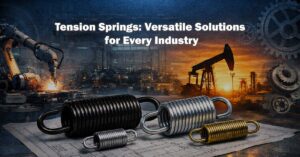
The applications stretch across nearly every industry with moving parts. Automotive systems lean on them for return mechanisms in doors, seats, and control assemblies, the kind of quiet, repeated motion drivers never think about until it stops working smoothly. Agricultural machinery puts them through a rougher test of repeated stress, dust, and outdoor conditions that shift with the seasons.
In electrical and electronics assemblies, the springs are often small enough to go unnoticed, but they’re keeping contact pressure steady or pulling switches back to their resting position. Home appliances tell a similar story, with washing machines, trampolines, and garage doors all depending on tension springs to hold up over thousands of repeat cycles without losing their return force. Industrial and elevator machinery sits at the far end of the spectrum, usually needing custom-engineered springs built around exact load and cycle requirements.
Because the applications vary so widely, off-the-shelf springs don’t always cut it. A garage door spring and a fuel system spring might share the same basic mechanical principle, but their tolerances, materials, and end configurations are worlds apart.
Why the right manufacturing partner matters
A few things worth checking before choosing a supplier. Ask whether they actually test for load tolerance and cycle life, or if their quality checks stop at dimensional accuracy. Batch consistency matters too, so find out if they can move between prototype runs and high-volume production without quality drifting from one batch to the next.
Traceable raw materials and recognized certifications are worth confirming upfront rather than assuming. And don’t settle for a supplier who only offers catalog options if your application actually needs custom hook and loop configurations, since forcing a standard part into a non-standard application is where a lot of premature failures start.
This is where working with an established name among spring manufacturers in India actually pays off. Decades of manufacturing experience show up in details easy to overlook on a spec sheet, but that matter enormously in real-world performance, like consistent coil formation across every batch and load characteristics genuinely matched to the application.
Benefits of well-engineered tension springs
When a tension spring is designed and manufactured correctly, the payoff shows up in a few concrete ways. The return force stays reliable cycle after cycle, and downtime drops because a well-matched spring isn’t likely to fail without warning. Get the spring wrong, though, and it can throw off an entire mechanism’s timing in ways that aren’t obvious until the assembly is already underperforming, and replacing failed components again and again adds up fast, usually costing more than sourcing the right spring the first time.
Precision matters here more than people expect. A spring off by even a fraction of a millimeter in wire diameter or coil spacing can behave differently under load than the design intended, and that difference compounds over thousands of extension cycles.
Questions worth asking before you order
Before finalizing a tension spring order, it helps to have clear answers to a few basics: the load range required, the extension length and available space, the environmental conditions it will face (indoor, outdoor, exposure to moisture or chemicals), and the end configuration that actually fits your assembly, whether that’s a German hook, English hook, or extended hook.
Getting these details right at the design stage avoids costly rework later. Most experienced manufacturers walk through these questions with you rather than simply taking an order.
Getting it right the first time
Tension springs might be small components, but they carry real mechanical responsibility in whatever system they’re part of. Whether you’re designing a new product or sourcing replacement parts for existing machinery, working with a team that actually understands load behavior, material science, and application-specific engineering makes a measurable difference in how long the part lasts and how well it performs. If precision and consistency matter for your project, it’s worth reaching out to established spring manufacturers in India who can walk you through everything from initial specification to final delivery.


No comment yet, add your voice below!