

A production line grinds to a halt mid-shift, and after twenty minutes of troubleshooting, the culprit turns out to be something almost embarrassingly small, a spring inside a stamping press that’s lost its tension and stopped returning the punch to position correctly. Nobody budgeted downtime for a component costing a fraction of what the machine itself is worth, yet there it is, holding up an entire production schedule.
This is the quiet reality behind most manufacturing machinery. Springs rarely get attention until one fails, even though they’re doing constant, repetitive work inside presses, conveyors, valves, and other mechanisms keeping a factory floor moving. Spring manufacturers in India supply this exact category of component to industries that can’t afford unplanned downtime, and knowing which spring type belongs where goes a long way toward preventing the kind of failure that stops a line cold. This piece walks through the main spring types used across manufacturing machinery, where each fits, and what separates a spring that holds up from one that doesn’t.
Why Springs Matter More in Machinery Than People Assume
It’s easy to think of springs as a minor detail, but in manufacturing equipment they’re often doing the actual work that makes a machine functional, storing energy, returning components to position, absorbing shock, or maintaining constant pressure across thousands of cycles a day. A spring that’s undersized or made from the wrong material doesn’t just wear out faster, it introduces inconsistency into a process that depends on precision to run correctly.
Compression Springs in Presses and Stamping Equipment
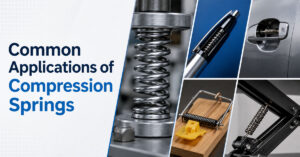
Compression springs are probably the most widely used spring type across manufacturing machinery.
Applications:
- Stamping presses and punching equipment, returning the punch to its position after each cycle
- Conveyor systems, adding tension and cushioning at transfer points
- Valves and actuators, maintaining pressure through repeated cycles
- Packaging and assembly line machinery, absorbing shock at high-speed contact points
These springs cycle continuously, hence, sometimes thousands of times a shift, resistance to fatigue is more important here than nearly any other property. A compression spring that performs well for a hundred cycles but degrades by cycle ten thousand isn’t suited for continuous manufacturing use, regardless of how it performed in testing.
Tension and Extension Springs for Return Mechanisms
Tension springs, sometimes called extension springs, work opposite to compression springs, stretching under load and pulling back to their original length once that load is removed. In manufacturing machinery, they show up wherever a mechanism needs to return automatically after being pulled or extended:
Applications:
- Return mechanisms on levers and mechanical arms
- Counterbalance systems on machinery covers and access panels
- Tensioning devices on belts and chains
Getting the hook design and attachment points right matters more than people expect, since a tension spring under repeated load tends to fail at the connection point long before the coil gives out.
Torsion Springs for Rotational Movement
Torsion springs store and release rotational force by twisting along their axis, rather than compressing or stretching linearly.
Applications:
- Hinged machine guards that need to snap back into a closed position
- Rotating levers and pivoting mechanisms
- Safety interlocks and access doors requiring automatic return-to-position behaviour
Equipment relying on this kind of automatic, repeatable return movement generally depends on torsion springs specifically, since compression or tension springs aren’t built to handle rotational displacement the same way.
Conical and Specialty Springs for Tight or Vibration-Heavy Spaces
Conical springs have a tapered, cone-shaped coil rather than a uniform cylindrical one, allowing them to compress to a shorter solid height than a straight-sided spring of the same wire diameter. They also resist buckling under lateral load better than standard compression springs.
Applications:
- Machinery with limited vertical clearance for a standard spring
- Equipment experiencing vibration alongside axial force
- Factory floors running multiple machines close together, where space and stability both matter
This combination of compact size and lateral stability makes conical springs a practical substitute wherever a standard compression spring simply won’t fit or hold steady.
Wire Forms and Custom Components
Wire forms aren’t a standard catalogue spring at all, they’re shapes engineered specifically for one mechanism, built to hold, retain, or fasten rather than to store and release energy the way a coil spring does.
Applications:
- Clips and retainers holding a panel or component in place
- Retaining components under vibration
- Specialty fasteners built as part of a larger mechanical assembly
Because these parts are usually application-specific, working with a manufacturer capable of custom engineering matters more here than with standard spring types.
What Actually Determines Whether a Spring Holds Up
Material selection and manufacturing precision matter more here than most buyers assume. A spring’s coiling range, wire diameter, and heat treatment affect how consistently it performs across the exact load and cycle count a machine demands. Manufacturers working across a coiling range as wide as 0.10mm to 12.00mm, with proper heat treatment and testing behind each batch, tend to produce springs that hold their rated force more consistently than generic alternatives.
IATF 16949 certification, the automotive-grade quality standard, is worth checking too, since the testing discipline required for automotive-grade parts tends to carry over into everything else a facility produces.
Choosing the Right Spring for the Right Machine
These categories aren’t interchangeable, even when a spring might physically fit into more than one assembly. Choosing based on load direction, cycle frequency, available space, and environmental exposure, rather than defaulting to whatever’s stocked, tends to be the difference between a spring that lasts the machine’s operating life and one that becomes a recurring maintenance item.
Accurate Springs Pvt Ltd has manufactured precision springs for manufacturing and industrial machinery for over four decades, supplying compression, tension, torsion, conical, and custom wire form components to industries ranging from textile machinery to home appliances and elevators. With certified facilities in Chennai and Coimbatore, the primary focus is to ensure that the spring specification matches with the machine it is built for.
If your production line is sourcing springs for machinery that cannot afford unplanned downtime, it is worth the extra diligence before placing an order to work with spring manufacturers in Coimbatore who understand the engineering and operational stakes involved.
FAQs
1. What’s the most commonly used spring in manufacturing machinery?
Compression springs, because they are exposed to repeated push-back force in presses, valves and conveyors more than any other.
2. What is the difference between a torsion spring and a compression spring?
A torsion spring stores rotational force when twisted, a compression spring stores linear force when compressed.
3. Why are conical springs useful for tight spaces in machinery?
They are tapered so they can be compressed down to a shorter solid height than a standard spring. This is useful when space is limited.
4. Can Accurate Springs manufacture custom wire forms for specific machinery?
Yes. Custom wire forms are designed specifically for the mechanism they are built for, rather than using a standard catalog size.
5. What actually determines how long an industrial spring lasts?
Material selection, wire diameter, heat treatment, and manufacturing precision, tested against the real load and cycle count required.


No comment yet, add your voice below!