

Precision is what makes industrial automation possible; thus, each motion, rotation, and return movement must be designed and engineered to be able to work repeatedly with little to no chance of failure. Although many manufacturers are unaware of how important the coil springs are in relation to industrial automation; torsion springs offer controlled torque allowing for precise and stable rotation of components as well as accurate repeatability for automation. Therefore, as more manufacturers adopt automation as a method of producing their products, torsion springs will continue to be an important mechanical component for Spring Suppliers in Chennai.
What Makes Torsion Springs Essential in Automation Systems
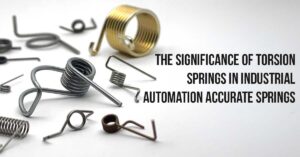
Torsion springs (twisted coil springs) are utilized to store energy in the form of twisted coils which create rotational force when released from a twisted state. Because torsion springs work by creating an angular motion instead of a vertical or horizontal motion, they offer a very controlled and predictable method of return movement.
Torsion springs are often used in industrial automation applications and are typically produced with continuous cycling capability. These springs have been engineered with extreme precision, and their performance is influenced by several design components, including coil geometry, leg configuration, the limit of torque applied to the spring and strength of material used to produce the spring. When designing a torsion spring, even a small deviation from the original configuration will adversely affect the machine’s ability to produce accurate, efficient and safe operation.
Why Automation Relies on Torsion Springs
To meet the requirements for repeatability associated with automation, torsion springs must provide constant torque through a series of repetitive mechanical movements over long periods of time (i.e., numerous operating cycles) to support applications that require continuous operation.
The torsion spring’s role in automation includes:
- Maintaining a consistent rotational force without the need for any powered means of creating this torque
- Supporting compact mechanical designs where a significant amount of space is not available
- Reducing the amount of load placed on Motors and Actuators by absorbing all of the stresses associated with rotation
- Providing predictable performance in order to enhance the reliability of the mechanical system
Mechanical operation of torsion springs helps increase energy efficiency and reduce the complexity of the overall system. Modern automation equipment must achieve a balance between energy efficiency and increased complexity while providing high levels of accuracy and reliability.
Torsion Springs Used in Industrial Applications:
Automated Machines & Assembly Lines:
Most clamps, guide mechanisms & return mechanisms are constructed with torsion springs, allowing for consistent product output and no need to reset or readjust between production cycles.
Robotics & Motion Control Equipment:
Robotic systems use controlled movement and proper balance through the use of torsion springs to allow for stability when managing rotational loads, absorbing shock and maintaining control over motion. This leads to improved accuracy of positioning and longer life for motors and joint components.
Security & Control:
All safety types often have a fast acting mechanical part associated with them. Mechanical devices that are actuated by the mechanical means of a torsion spring are actuated in many ways. Torsion springs are applied in emergency shutdown systems, safety covers, and security locks (where timing must be impeccable).
A sample of applications of torsion springs:
- Return action of safety guards
- Mechanical locks actuation
- Fail-safe placement when power supply is interrupted
Electrical & Electro-Mechanical Systems:
Switches, relays, and circuit breakers will incorporate a torsion spring to achieve speed and accuracy in actuation. In a high automation environment, electrical reliability requires the same mechanical precision as electrical reliability.
The Importance of Custom Design in Automation
With the increasing specialisation of automated systems, standard torsion springs may not be suitable for performance specifications. By creating custom designed springs, manufacturers have the ability to produce springs that provide the right torque value at each required angle and in the correct operating environmental condition.
Key design considerations are:
- Torque requirement through an effective range
- Cycle life and defined fatigue resistance
- Temperature operating conditions and exposure to them
- Space constraints for assembly within machinery
Custom torsion springs increase the efficiency in operating machines while decreasing the time between machine maintenance and supporting the long-term stability of the machines.
Material Selection and Long-Term Performance
Material choice is the single most important factor for how a torsion spring operates in the long term. High carbon spring steel is the most commonly used type of material for general industrial use. Stainless steels and alloy steels are generally used for applications where the torsion spring is exposed to moisture, high temperatures, or corrosive versus non-corrosive elements.
High-quality torsion springs will maintain a consistent amount of torque over millions of cycles, while low-quality torsion springs may lose their elasticity, causing machines to behave erratically and poorly and/or reduce accuracy and increase downtime.
Partnering with the Right Spring Manufacturer
In order to have a positive impact on an industry through automation, it’s important to get torsion springs from a qualified supplier with extensive experience in manufacturing. An experienced supplier can provide the necessary precision tooling, quality testing, and engineering assistance to successfully design, manufacture, and support integrations of torsion springs into complex systems.
Accurate Spring provides torsion springs that are designed for use in an industrial environment. Their manufacturing expertise allows them to produce torsion springs that are used in many different areas where automation is applied, so that industries can use them to improve their efficiency and reduce the risk of mechanical failure.
Although torsion springs function quietly in the background, they play an essential role in industrial automation through aiding controlled motion, enhancing reliability, and improving safety in automated processes. As industry moves more towards automation, the requirement for precision engineered springs will increase.
Selecting reputable torsion spring manufacturers such as Accurate Spring provides you with High-Performance Torsion Springs that offer maximum durability, precision, accuracy, and long-term use in your industry.




No comment yet, add your voice below!